
Tree Services Information
ServiceS
Areas & Regions
We provide tree lopping to all suburbs including North Shore, Hills District, Inner West, Southern Sydney, Eastern Sydney, South-Eastern Sydney, South-Western Sydney.
Locations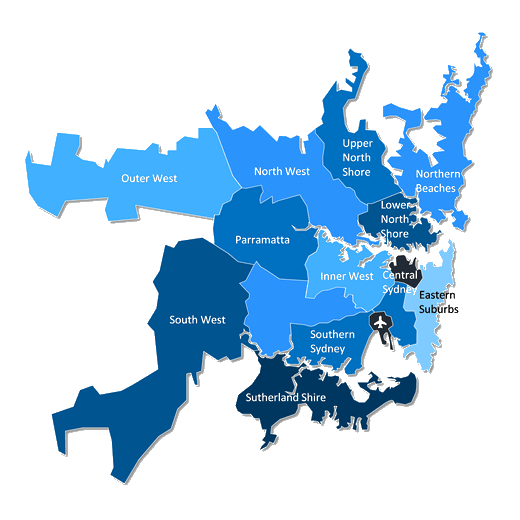
Move the mouse over the button to open the suburbs menu.
It is important to keep note that tree removal cost generally do not include the cost of removing the tree stump unless otherwise stated. Factors affecting tree removal price are complexity and time effort:
- Size of the Tree– Larger trees requires more effort, heavy equipment and harder to dispose as compared to a smaller trees.
- Type of Tree– Not all tree can be recycled. Depending on species of tree, type of hardwood trees as they requires more time to process than soft wood trees.
- Condition of the Tree– Disease infested tree or rotten tree are more risky to climb, and usually require equipment like cranes to bring them down safely, adding to your costs
- Access– If the tree is located in awkward location like the rear of a property inaccessible to trucks and equipment, then special effort will be required. Other access situations include obstacles, position of property (level and steepness), waterfront tree removal requiring barge access, Quotation is dependent on variations to access equipment and resource needed.
The cost of removing the tree stump is generally not include and need to be requested separately unless otherwise stated.
Tree removal of a good size tree requires a team effort, equipment, skills and most likely the Council permission to remove a tree from your property. Situations where the council permission to remove a tree are needed are as follows:
-
- If the tree is likely to cause property damage to houses or buildings;
- That there is evidence that the tree is structurally unstable and may cause hazard to remove.
- That the tree is causing structural damage to the home structure.
- If the tree is in a state of decline and reaching end of life.
Land owners do not require local government permission to remove vegetation if the property occurs in a designated bush fire zone. Only requirement is the property must meets the 10-50 meter rule (i.e. tree that lies within the area of the 10 to 50 meters from the external walls of the building).
Some of reasons why an arborist tree inspection may be required:
- For property developers when applying to council for development approval(DA);
- Used by homeowner applying for or renewing mortgage home insurance policies;
- When a homeowner received a tree preservation order from the local council.
Typical arborist tree report includes:
- faults or damage to the tree rendering it unsafe / unsuitable;
- type of disease or pests causing sickness to the tree;
- approach procedure used to make assessment;
- tree species and type;
- recommendation for actions and/or justification for removal;
- supporting documentary evidence;
- photography
Please go to this link and complete the online form:
https://www.cbcity.nsw.gov.au/onlineservices/application-to-prune-or-remove-a-tree-on-private-property
Bankstown Development Control Plan – Part B11 – Tree Management Order
Canterbury Development Control Plan – Part B3 – Tree Management Order
Council is responsible for protecting trees with Tree Management Orders (TMOs). They are made under the NSW Environmental Planning and Assessment Act 1979. They prohibit a range of activities relating to their removal or destruction, and you should check before doing anything to a tree as there are fines for non-compliance.
Exempt activities
You don’t need to ask us for a permit to prune or remove trees in certain circumstances, including:
- The removal of dead or dangerous trees where it can be proved by the owner to Council’s satisfaction, as outlined in the current Development Control Plan;
- The control, removal or eradication of a declared noxious weed;
- Where trees have been approved for pruning or removal under a current Development Consent issued by Council; and
- For the pruning of trees, where these are grown and are clearly identifiable as a hedge unless heritage listed. Removal of hedges requires Council approval.
This information is indicative and you should always seek your council advice before you seek tree to be removed.
Approval is not required to remove the following trees:
| Name | Species |
|---|---|
|
Willow |
Salix species |
|
Poplar |
Poplar species |
|
Cootamundra Wattle |
Acacia baileyana |
|
Coral Tree |
Erithrina sykesii |
|
Rubber Trees |
Ficus elastica and hybrids |
|
Golden Cypress |
Cupressus macrocarpa “Brunniana” |
|
Norfolk Island Hibiscus |
Lagunaria petersonii |
|
Large Leafed Privot |
Ligustrum lucidum |
|
Small Leafed Privot |
Ligustrum sinevise |
|
African Olive |
Olea africana |
|
Camphor Laurel |
Cinnamomum camphora |
|
Umbrella Tree |
Schefflera actinophylla |
|
Cocus Palm |
Syagrus romanzoffiana |
|
Rhus Tree |
Toxicodendron succedaneum |
|
Honey Locust |
Gleditsea Triacanthos |
Council is committed to minimizing tree loss in your suburb.
Trees benefit our environment by:
- Enhancing the street scape;
- Reducing climatic extremes;
- Improve air quality; and
- Provide habitat for native wildlife.
A flexible approach to assessing applications to remove or prune trees will ensure that trees of high aesthetic and environmental value are only removed when deemed necessary.
Tree Removal Permit
Anyone wishing to prune or remove a tree must obtain approval from Council by completing the Prune or Remove a Tree on a Private Property Application Form
Council considers a variety of issues when assessing applications for the removal or pruning of trees. These considerations are fully outlined in Council’s Tree Management Policy.
Issues which do not usually warrant removal/pruning of trees include the following:
- A tree is shedding leaves, fruit, bark, cones or twigs. During the natural process of a tree’s growth leaves, flowers, fruit, seeds or small elements of deadwood will fall. This will not form the basis for permitting the removal of the tree(s)
- A tree is causing minor structural damage, such as footpaths or driveways.
- There are fears about healthy trees failing.
- A tree is causing minor shading.
- A tree is causing blockage to pipes, unless the damage is serious and recurring. Root pruning, replacement of old dilapidated pipes, or use of root barriers may solve the problem( evidence would need to be provided if the problem is serious)
- Pruning for amenity views.